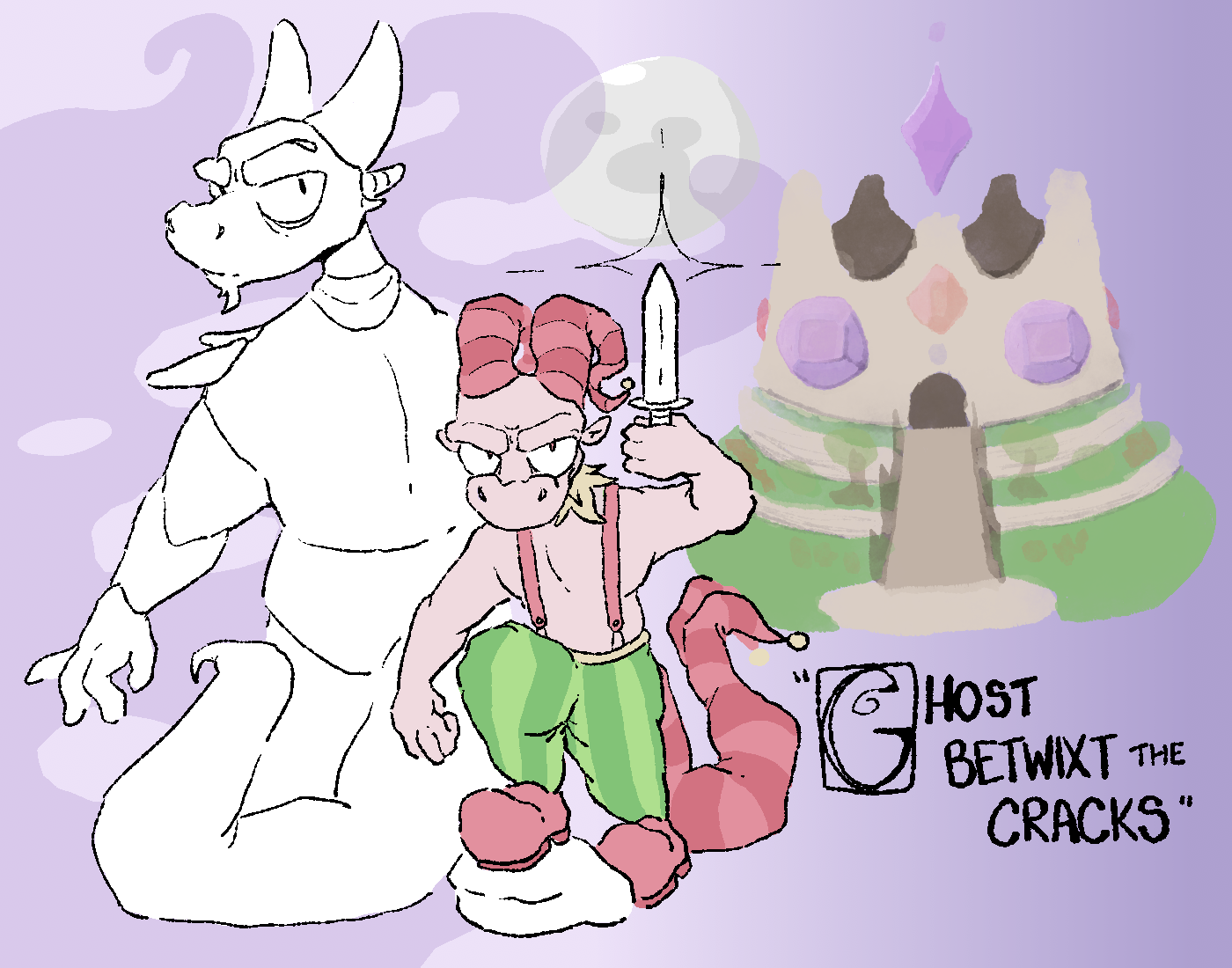
Ghost Betwixt the Cracks
Most of the residents of Hollandia have been transported to a pocket-dimension owned by the Keymaster, an eccentric sweet-manufacturer turned conjurer. Meanwhile, the incompetent Universe-Father — known to the heroes by his true name, Liverwurst — is struggling to keep the world alive as it continues to unravel through an unknown means. He has sent his subjects Puck and Hildegard to the castle of the Dragon King, the place where Puck was born and raised, to investigate a vague "problem".
Read in PDF format
• • •
SCHOLARLY wisdom dictated that the Dragon King's castle had stood atop Hollandia's second-highest peak, housing its second-highest monarch, for hundreds of thousands of years. Its facade assumed the shape of an enormous crown, with spires protruding from a circular ring inlaid at regular intervals by enormous polished gemstones, obtained from an unknown place by a mechanism lost to time. Surrounding the central structure was a series of terraced gardens; they gave way to a luxurious lawn traversed by a single straight cobblestone path, which deviated to form a circle around a grand water fountain. A stairway led up the terraces to the castle's entrance, where two oaken doors, marked by intricate golden engravings whose meaning could perhaps only be discerned by the King himself, stood ajar. Behind them all was darkness.
Aside from the steady bubbling of water, there was not a sound to be heard. Guard posts stood un-guarded. Intricate networks of topiary stood un-bothered. The King had moved elsewhere, alongside the Keymaster and what remained of his royal entourage. For the first time in its un-recountable existence, there was no trace of sentient activity at the castle on the peak. Still it remained, even after the lower part of the mountain, with the surrounding villlages, had succumbed to the dissolving fog which enveloped all things that were deemed a strain on the diminishing energy-supply of the universe. The castle simply wouldn't go away; at least, that was what Liverwurst had said as he lit the ghostly purple path to the summit.
How could the father of the universe — incompetent as he may have been — fail to destroy a structure made by his subjects? Did they have something he didn't? The whole situation was quite perplexing to Hildegard, who stood at the far end of the lawn, half-emerged from the swirling fog behind him, squinting at his tiny blue reflection in a sapphire the diameter of a dinner-table.
"Welcome to mi casa," said Puck to nobody. Once the fog cleared, he suddenly picked up his stride, as if motivated by the thought of something further ahead, but his gaze refused to linger in any one direction. He trotted heedlessly across the trimmed grass so that the two travellers were soon separated by a fair distance. This was the place where he, the unbreakable defender of what was now called the Over-Plane, was raised — not as a knight or guardsman, as his travelling companion had been, but a jester, descended from a line of lowly entertainers of a dishonourable race, who lived and died as laugh-fodder for the King's court.
It had never occurred to Hildegard to ponder that old state of affairs, even though Puck made no effort whatsoever to hide where he came from, and anyways would not be able to if he tried; the striped horns protruding from his head betrayed his origin immediately. Hildegard could not disagree when the Cranes had claimed that "frivolity was written all over him". It also seemed, however, that Puck's features had taken on a greater and deeper significance than that, and when Hildegard tried to imagine him performing the rude parlour-tricks he'd seen elsewhere, no coherent pictures came to mind. Then he remembered that it had somehow not yet been a year since Puck was dragged from that lowly position against his will. The entire thought made no sense, so it fizzled out as if it had never existed at all, reducing once more to the formless fog of perplexity.
The travellers met at the base of the grand fountain.
"Once, I watched a guard fall in here. They were changing their positions and — you know the big masks those guards wore, with the eye-holes and the feathers? — they can't see through them at all! He went right over the edge.
Imagine that. A bunch of guards who can't see. The whole thing was a mess."
Hildegard gave a barely-perceptible chuckle. "You must be joking."
"I was the only one who saw it happen. Or, I think I was. He quietly went back to his post, and stood there 'til sundown, dripping wet, because he didn't want to make a scene."
Puck was seated on the fountain's edge, idly tracing circles in the water with his hands. It was an intricate affair of bronze and plaster, composed of multiple bowl shapes shouldered by sculpted models of Lisks, each one dripping with water and frozen in a thousand-year grimace as they performed the imaginary task of holding the bowls aloft. Atop the highest bowl stood the radiant figure of the Patron, four feathery wings unfurled. He clutched a sword in one hand and a tome in another. The figures on the tier directly below him also had wings, at various stages of sprouting; it raised the question of whether this scene depicted some ability lost in the early years of his race's foundation, or was something merely figurative, or if the Patron had actually existed at all outside of folklore.
"There used to be a beach here, on the other side of the mountain. But it's gone now." Puck removed himself from the rim of the fountain and looked at Hildegard. Something had changed, for he now appeared entirely calm and resolved. "Let's move."
The two proceeded together to the stairway upon the terraced gardens. Hildegard had previously only seen these gardens from a distance, and he knew that he would likely be the last to see them in a cultivated state. Yet the only image that left an imprint on his memory was that of a gnarled olive tree, before he and Puck crossed the final stair and came to those great wooden doors embedded in the gem-studded walls.
• • •
The walls contained a verdant courtyard, comprised of concentric paths around a great earth-mound in its centre. They were lined with symmetrical rows of topiary, designed to resemble the Dragon King's royal seal when viewed from atop the keep, whose looming shape stood at the end opposite the gate.
Puck had been told that he would never set foot in this courtyard again. Perhaps that prediction was not entirely incorrect. It was not the same place he had been exiled from on that bitterly cold winter's evening; there was no chatter on the other side of the pond, no rustle of birds' wings atop the ramparts, and a cold unearthly breeze swept its diameter in a way that it never did before. Hildegard's presence obliterated any trace of familiarity that may have otherwise remained, so that in this castle — the new castle, formed from the fresh carcass of the old one — they were both tourists.
It was not this realisation that lent him his sudden spark of resolve, however; in fact, he was more apprehensive than before. Anger was what drove him onward most of all. The memory of the beach reminded him that the great dissolving fog only descended upon places that were empty, lifeless, finished with their purpose, and this led to one conclusion: Liverwurst knew that someone, or something, was living here, and had refused to admit it. Why would he attempt such a brazen lie at a time like this — a lie that he surely knew his subjects would see through? If he was listening now, he gave no answer.
There was one thing to try.
"Stand on top of the mound," he said. "I think this calls for one of those 'invocations' we were told about".
"But we were directed to this exact place. How could anything like that help us?"
"Whatever's here isn't going to come out on its own." Through a clearing in the foggy dusk sky (it had been dusk since the two began their climb to the peak), the full moon appeared, glaring at Puck in the manner that had once terrified him. "We'll give it one earnest try," — he steeled himself — "and if it doesn't work, then there's nothing more we can do." At once, the breeze picked up, howling through the open doors and around the courtyard, and then died down, so that the courtyard was stiller than before.
The mound was almost an island, situated within a large pond in the centre of the courtyard and made accessible by a narrow land-bridge on its far side. At its peak, overgrown by bush and concluding a well-trodden spiral path, stood the circular remnants of a primitive castle-keep that was older still than the structures surrounding it, weathered to little more than a stony ring embedded in the grass. The lanterns that once lit the path had burnt out some days ago. When the pair reached the top, they stood in near-complete darkness, save for the fog-scattered light of the moon.
Hildegard handed Puck one of his daggers, according to the procedure they had been taught. In the hands of the latter it was nearly a shortsword, scuffed all over with a handle wrapped tightly in strips of leather. He stepped forward, onto a rocky outcrop which gave him a view over the castle walls past the enormous lawn, and lifted it skywards. The tip appeared to glow.
"All those souls who remain here— "
He stopped, remembering his former living-quarters, situated at the top of the towering donjon behind him; suddenly he felt that something would emerge from them and take him by surprise. After a moment's hesitation, he decided not to turn around — anyway, he was not alone. The pond-water shimmered below.
"It is I, the appointed defender of the Over-Plane, arrived to carry out the will of her father. I was born within this castle, raised in the service of its masters; now they are gone, and I return."
Silence.
"My station was not high, as you can surely see. Yet I have no choice but to fulfill the responsibility with which I am entrusted.
I do not want to kill; I shall do only what is necessary to keep this universe from bleeding dry. If you oppose me, show yourself now."
The final sliver of dusk's light slipped below the horizon, leaving the sky to be consumed in a uniform eggplant-coloured haze, but all remained quiet and crystal-clear, so that the bubbling of the intricately-sculpted fountain outside was still audible from much too far away. A chill set into Puck's bones — what if there was no answer? Was it possible for whatever spirit was keeping this castle alive to remain stuck here, because of some mechanism that was too strong for the Universe-Father himself to break?
Then, slowly at first, the wind began to blow around the circumference of the mound, sending leaves fluttering into the air, and although only Hildegard noticed, the dagger-blade was certainly glowing now.
"Come out-!!"
A deafening crash: thunder. Everything turned white, then purple, as the lanterns on the mound lit up with ghostly pseudo-flames. A gale whipped at Puck's feet, and rain assaulted him from all sides; he lowered his head to spare his eyes, still holding the dagger aloft as it hummed with electricity. Standing on the rocky outcrop, he saw that there was nothing below him but water. He stumbled.
"Keep your head up!" shouted Hildegard. From behind, Puck was a silhouette against the shimmering outline of the moon.
Falling, he caught himself on his hands and knees, but lost his grip on the dagger, fumbling for it helplessly as it ricocheted from the mound's stony face into the pond — once, twice, and then it was gone in a graceless splash, in the spot where there was a dark mass forming in the water below. He only had a moment to wipe the rain from his eyes. Then, instantaneously, a colossal geyser of foam shot upwards, far above the mound. A white shape emerged from it and came searchingly down upon the furthest edge of the outcrop mere inches from his face; it was a great claw made of sinew and bone and slick with algae. Another foam pillar, and another claw, materialised to its left. Puck, spitting out a mingled pond and rain-water mixture, forced himself with eyes shut to his feet, drawing his mace. When his sight returned, he took a half-step backwards as he found himself in front of a towering mound of stinking flesh.
He and Hildegard, who had been standing at the high-point of the mound with blunderbuss drawn, gaped at the creature as it rose, mud cascading from its back, higher and higher until it towered well over either of them. Its hands and face were pale, with empty sockets in place of eyes and bones showing through a strained network of muscles and tendons. The remainder of its mass was black-turning-brown. Hanging from its neck and shoulders were dark-coloured strips, which could have been strands of pond-weed or sloughing flesh or both, although it was difficult to tell in the spectral purple glow of the courtyard.
All three stood still. The cascade of mud and water from the creature's body slowed to a drip. A gush of warm air met Puck's face from its python jaws — bitter, then putrid, then sticky. Bile rose in his throat as he stared into its gaping pitch-black maw.
At the back of its throat, in the place where its uvula ought to have been, he spotted two white pinpricks. He blinked his nauseous tears away; the pinpricks were enshrined with dark-green circles. The eyes, hazy but still moist, met his for a moment, and his head stopped spinning. The jaws shut once more.
Puck looked sternly between its pointed teeth. "State your name."
A sound emanated from the skeletal head, half-voice and half-wind. "Turn around," it said. "Leave this place".
"I won't. Not until my mission's done."
Rain continued to pour. The creature shifted, turning its head downward to the pond and back again. With a laboured breath, it began:
"You wish to know who I am? Very well.
I once was a servant of the King,
faithful in most everything.
A court musician, I was raised
in ballads, jigs, and serenades.
A lowly job, but nevermind;
my needs were always well-supplied.
Alas, my tenure was cut short,
when one old conjurer came to court,
who'd made a world for everyone,
of endless joy and infinite fun!
'Hurray! Hurrah!' I cried with glee,
'A world where all are just like me!'
And so departed everyone,
the King, the Queen, their triplet sons,
gardeners, guards, and royal cooks,
keepers of the secret books,
frumpy maids and lovely belles,
even crooks in holding cells!
All the castle left that day,
But me! but me!
I was made to stay.
'We've no more need of you', they said,
'newer things are up ahead.
You're out of date, dried up, a bore.
Take the castle — ha! — it's yours.'
When I tried to chase behind,
the swirling fog trapped me inside.
So I haunted the castle all alone,
'round the floors of smooth-cut stone.
Staged lovely banquets in the hall,
attended by no-one at all.
The lights went out, room by room.
My famous home became a tomb.
One day, I climbed atop the mound,
peeked over th' water,
oops! — tumbled down.
I am the ghost betwixt the cracks,
I slipped, and fell, and can't get back.
As for my name — if only I knew that!
A tragic tale, but nevermind;
I was a ghost long ere I died."
At the conclusion of its recital, the creature leaned forward, breathing heavily, bending a long finger just shy of Puck's face as if invisibly restrained. He reeled a moment before finding his footing again, fiery determination etching itself upon his brow. "We have many things in common."
"We do not know each other at all," it replied. "That is why you have come to fight me."
Puck smiled imperceptibly. "So you have proven me correct." His grip tightened on his mace. "There was a time when I, too, did not know what a fight was for."
• • •
The sickening crunch of steel on bone echoed through the courtyard.
Puck took advantage of the moment of disorientation to leap from the mound onto the looming flesh-beast's neck, where he landed two more blows as it rose from the pond, each one scattering shards of skull-matter.
"Your blows only cause me to sink deeper... deeper..." it moaned, writhing in an attempt to wrest Puck from its back. He, however, knew better than to believe he was causing any genuine pain. The bulk of the creature's snout was nothing but a shell, rotted down to the bone; it could not have possessed sensation, and was therefore no different from armour. A spindly arm came up to grab Puck, but Hildegard fired a shot from his vantage-point which entered his target's armpit, causing it to whirl around once more in a motion that suggested fury. Puck was flung to the ground. When his vision returned, he found himself with his back to a stone-brick wall — one of the walls which comprised the great banquet-hall. He was bleeding from his nose.
Hildegard continued to fire, trying to keep the beast's attention away from Puck as he righted himself. Each shot buried itself in its filthy hide, and each one drew blood, but they barely slowed it down; indeed, they did not prevent it from turning on all fours towards the hall. Puck was on one knee, trying to stand with the support of his mace, but his head continued to spin. A black mass sped towards him with astonishing velocity. Its hand came down — he shut his eyes tightly — and then Hildegard was on the hand, sawing at it with his second dagger. He had doubled himself.
"It won't stop unless you aim for the heart!" shouted Hildegard's double.
Catching his breath, Puck rose to his feet and leapt towards the chest of the distracted creature as it choked the double in its grasp. Through its paper-thin skin, the beating outline of its heart was clearly visible. He thrust the point of his mace towards it.
Blood gushed from the chest in rhythmic spurts, painting him a putrid red-brown. The heart's owner produced a sound that was little more than a grunt, as if it had stepped on a slightly angular pebble, but its grip loosened, releasing the double as it stumbled backwards, perplexed, towards the pond. Puck rode it by the grip of his mace like a harpooneer; hunter and hunted tumbled together into the ghost-lit water, thrashing wildly at first, then slowly, until its surface was still once more.
Despite the metres of stagnant water, the voice of the flesh-beast reached Puck unimpeded.
"So, you have banished this poor creature by force, but the pond feeds me; I will remain here forever, as I did before you came, bathing in my own blood.
Do you see, now? There was nothing for you to do but leave."
He struggled against its bony fingers, which trapped him on the muddy pond-floor like prison bars. It was impossible to swing the mace here; he could not even lift it. The water possessed an alien resistance.
"Goodnight, traveller. I suspect we will become friends. Good, good friends..."
But Puck did not feel himself drowning. A glowing mass swirled into view, barely within arms' reach from the edge of his prison; it was the dagger which he had dropped. Straining to pick it up, he sawed a numb finger-joint away, freeing himself, and swam upwards, past a sightless eye-socket into the creature's jaws, which lay ajar.
Suddenly it began to convulse, summoning energy which it did not have. "The throat! the throat! Anywhere but the throat!" It fought desperately to devour Puck, or crush him, or extract him from its bottomless gullet, but its tongue had long since rotted away; it had no muscle left to power its ferocious jaws; and there was no feeling in its bony hands. To its horror (horror?) it was entirely helpless.
In short order, he found what he was searching for: a glowing green pair of eyes. They were attached to the bottom of a lumpy mass at the top of his enemy's throat — a growth which was bright pink, shifting, pulsating. He looked into the eyes; they were watery. He looked upwards, and then back down. In the eyes he saw something like agreement, or resolution.
The dagger, still aglow, pierced the swollen pink mass.
Puck had barely made the incision when water began to rush into the mouth-cavity, sending him spinning into an indistinct wall of flesh. Everything went dark —
— and then he awoke in a coughing fit, belly-up on the bank of the pond and covered in a thin layer of slime. Hildegard's broad hands pressed repeatedly upon his ribcage. Each well-practiced compression produced a spurt of murky liquid from his mouth.
"Alright — alright — cut it out," he sputtered. "I'm awake."
"You're awake," Hildegard repeated. He remained on all fours for a moment, before himself collapsing onto the grass, face towards the sky. It was getting clearer; the mist was thinning, revealing a pale-lavender firmament which illuminated the courtyard like daylight.
Puck lolled his head to one side and nearly recoiled in fright at the sight of the beast's motionless face, which was lying sideways on the bank beside him. A stream of clear slime issued from its empty throat. Behind it, the great ancient mound stretched upwards.
"I s'pose I killed him."
"What else could you have done?"
"Maybe nothing. I thought I'd been more careful than that, is all."
"No matter."
A flock of birds in silhouette — possibly herons — flew over the castle, proceeding away from the edge of the world, towards the city at the bottom of the slope.
"He was in bad shape, of course," said Puck, following them with his eyes. "But for a moment it looked like he'd really make it."
The words became ridiculous as soon as he spoke them. Whomever those eyes belonged to had been absorbed almost entirely into that rotten creature which had manifested itself from the pond-floor; he would have been little more than a colourless life-force and a set of internal organs. There was no dagger-blade in the world precise enough to extract him from his prison.
I hope he had time, he thought. Time for what? Who knows?
"Perhaps a hike down the mountain would help to clear your mind," sighed Hildegard.
"Ha. You're a funny guy when you want to be..."
Gradually, the scene dissolved into a series of rhythms: the lapping of waves against the bank of the pond, the droplets falling from the terrible skeleton-head, the heaving of lungs inward and outward. In the travellers' great exhaustion, the mixture was strangely therapeutic.
Puck had a dream of being carried along a beach — the beach that had existed on the other side of the mountain, where he once laid in despair for three days and three nights after his explusion from the King's castle — on the back of a creature not unlike himself, who said that it had been wonderful to get to know him.
"What drove you out of the water?" asked Puck.
"Pure animal fear. All of a sudden, I was terrified, and didn't understand why."
He smiled ironically after its conclusion; all that he could recall of his companion's name was the first letter.
THE END
• • •