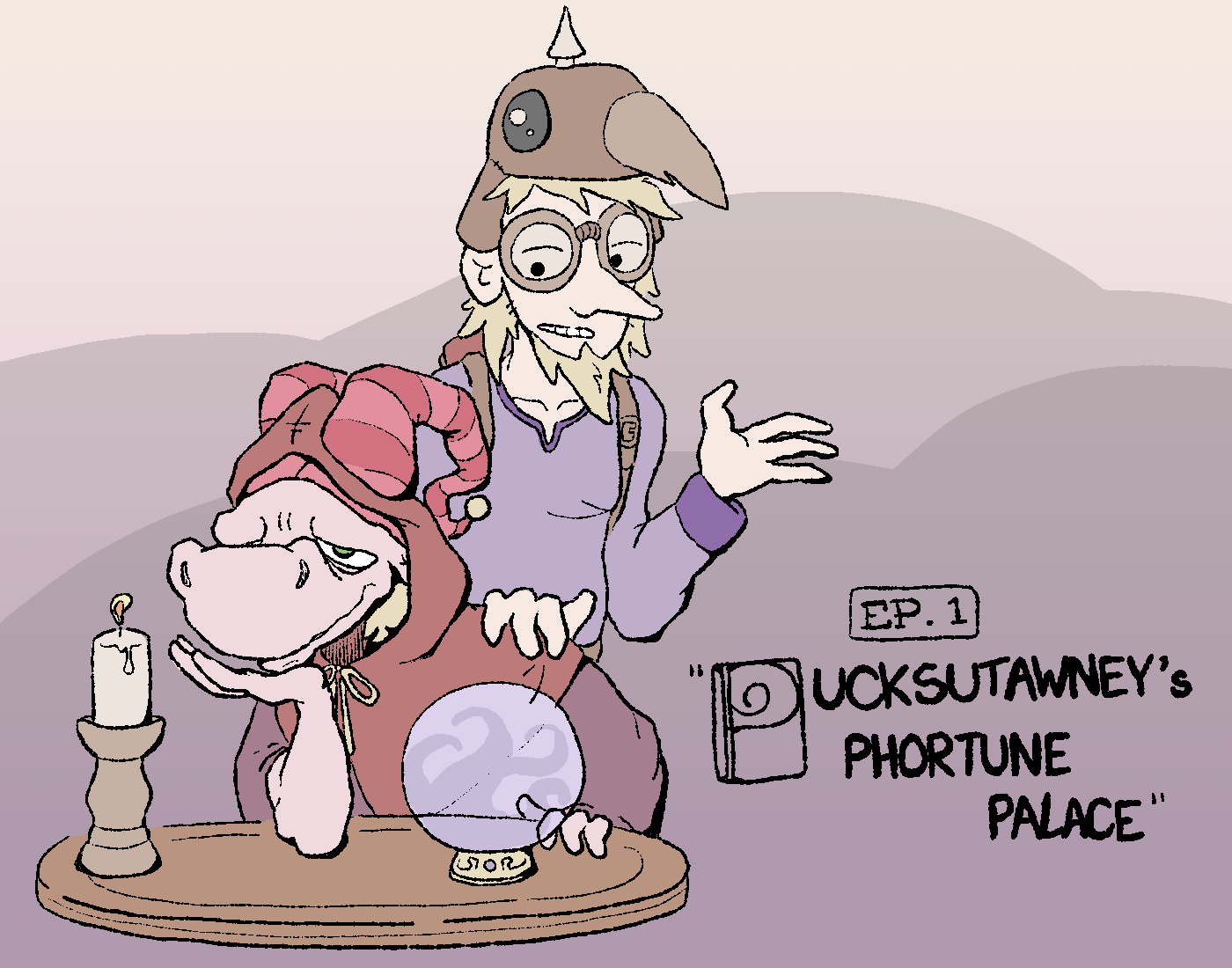
Pucksutawney's Phortune Palace
In Hollandia, the last town remaining in the world, disillusioned seer Puck "Pucksutawney" Puckster runs a fortune-telling tent on the outskirts of the Dragon King's castle grounds. A visit from a peculiar friend prompts him into reminiscing on a once-beloved story.
Read in PDF format
• • •
I: Lowlife
FOR a structure housing a business which had been strictly forbidden by decree, the fortune-teller's tent on the southern slope of the Dragon King's castle grounds was rather conspicuous; in fact, it was so difficult to miss the purple-striped pyramid, set atop a rocky outcrop at the hill's base, that one figured its owner was in some way looking for trouble.
Heedless of the stifling spring heat, dozens of travellers with no greater ambitions for the evening queued orderly outside "Pucksutawney's Phortune Palace" — as had been scrawled upon a wooden board hung above the tent's entrance — in varying states of fascination. Their fascination was not entirely unwarranted. Word had spread throughout Hollandia concerning the one inside: he was a monstrous exile from the castle on the hill, they said; a powerful magician, too, added those who were bold (and/or deranged) enough to believe in such things; and he had a mystifying ability of discernment, knowing everything about his visitors before they could make themselves comfortable at his desk, let alone speak a word. So it happened that each time the tent appeared beside an overgrown path or shade-giving tree, the crowd surrounding it grew larger, each of its members hoping to catch a glimpse of the storied fortune-teller before an altercation with the Royal Guard inevitably drove him away, in which case it would eventually, whether days or months later, appear once more in some other place.
Virgil Theophilus Lundqvist, a human by all possible definitions, stood near the front of the line, watching the afternoon sky with a hand shielding his brow. He knew the fortune-teller better than anyone; and so, having spied the tent from his cramped residence at the top of a nearby clock-tower, he had opted to pay the poor lad a visit. His presentation marked him as eccentric, even by the standards of the queue: his face was framed by a scraggly beard and locks of mousy-blond hair, a thick pair of metal goggles ensconced his eyes, and the centrepiece of his outfit, a feathered cap in the shape of an eagle's head, glimmered brown-and-yellow in the sun, adding half-a-foot to his already-generous height. For reasons largely unsurprising, he was known to his friends and associates simply as "Birdman".
The line moved forward. Birdman ducked to fit through the tent's entrance, wincing as he stepped barefoot on a rock.
"Take my place," he said, gesturing to a moon-faced teenager behind him. "I'm only here to watch." Puck was his friend, no doubt, but the prospect of having his fortune told triggered a deep discomfort he had surrounding the knowledge of things in advance. A bird-of-prey cannot know the outcome of a hunt before it begins; given that it were possible, it would defeat the purpose of hunting. So why should I? Satisfied with this expression, he stepped aside and sat upon a rickety chair in the corner, which seemed to have been placed just for him, and pulled his cap over his eyes.
The inside of the tent was relatively sparse, betraying the haphazard nature of the operation. Aside from Birdman's chair, a small round desk engraved with geometric patterns, and two cushioned stools, the only piece of furniture which gave off any sense of homeliness was the intricately-woven wool carpet in its centre, evidently worn and likely acquired for cheap from a secondhand market. A smell of burning incense (nevermind what kind specifically) filled the space, threatening to choke the nostrils.
On the far side of the desk, behind a dimly-glowing oil lamp and a crystalline sphere, sat the one whom the people had come to see: the seer, the freak-of-nature. His appearance was that of a fraudulent taxidermy, wrapped in a black cloak from which protruded a pinkish snout-like structure and two red-striped horns, each of which was affixed at the end with a small golden bell. Further, he was short — very short — so that, even with two thick volumes of Axioms of the Patron stacked beneath his seat, his beshadowed eyes barely reached above the swirling purple crystal-ball in front of him. He laid two ruddy hand-claws on the desk, breathing slowly and raspily like a dozing labrador.
Facing the fortune-teller, sitting himself down on the too-small stool in a confident manner which suggested a combination of authority and smug unbelief, was a tidy and well-built man who had been standing ahead of Birdman in line.
The two met eyes. A second passed before he spoke, gruffly: "Well — I'm here for a fortune."
"Who are you?" The small hunched figure in the cloak replied with a voice that was thin and wavering, as if holding in some strong emotion. "Tell me about yourself."
"You tell me, little guy. You ought to know."
A grimace appeared on the fortune-teller's concealed face, and he drew another breath while fidgeting with his hands. "Let's see here. You're well-off, but you do a good deal of manual labour. A farm owner, perhaps."
There was no reaction from his visitor. "Go on."
Sighing, he continued: "Last year... I'm seein' that last year's harvest was a difficult one, money-wise."
A flash of something passed the large man's face, but Birdman could not quite make it out.
"An' it was a tough year for everyone, what with the lack of sunshine, but you had it particularly rough, because... because of some other influence, right? I'm feelin' that there's a particular person you're thinking of."
"Hm. That's correct."
At this, the cloaked creature sat up straight, seemingly with new-found resolution, and begain to speak in a flat, unaffected tone, as flickering candlelight contorted his face into a variety of monstrous shapes. "You run an automaton-farm in the eastern quarter. Strawberries, I think—"
"Blackberries." The farmer shifted in his seat. Underneath his hat, Birdman's brows furrowed in concentration as he strained to listen more closely.
"Blackberries. Fine ones, too. You run it with your son — although he's really not made of the right stuff to take over the company, you think, 'cause he's always sneakin' out to go cock-fighting — but that's neither here nor there, I s'pose.
There's another automaton-farmer next door, with a V-name, pretty sure — vuh... vuh... nevermind — and you hate his guts. Hate 'em. Half of your crop wilted last year, and you're convinced, utterly convinced, that he sent one of his snot-nosed goblin servants over to salt the ground while you were sleepin'."
Nonplussed, the farmer leaned back and glanced around the tent, then leaned in to ask in a half-whisper: "Was I right?"
"Well — no. Not quite. But there is some good news. He's about to come on hard times himself. There'll be a reversal of fortunes, but twice as strong as the non-reversal. Come next year, your friend will be a pauper, and you'll have the market all to yourself."
"Really?"
The fortune-teller remembered to look at his crystal-ball, in which he saw nothing except for swirling lavender fog. "It's clear. Crystal clear," he sighed. "But that's all I can tell you for now. You'll have to come back another day, okay?"
Rising from the seat, the farmer placed a fistful of electrum coins on the desk, and with his other hand offered a handshake to the cloaked chimera opposite him, which was returned limply. "To be honest, friend, I severely underestimated you. You're doing a good and useful thing here, and for that, you have my gratitude." He glanced squintingly at the fortune-teller, trying to pick out his true features in the dark.
"Anytime," choked the fortune-teller, "anytime." Then he rose himself, standing atop his stool, and began to herd the rest of his visitors, groaning and grumbling, away from the tent. Although there was no indication that he had even been noticed, Birdman knew that he was to remain.
• • •
Uncloaked, in the orange glow of the sun which had begun to set behind the jagged towers of Hollandia in the distance, Puck "Pucksutawney" Puckster took on somewhat of a different character than was popularly ascribed to him. Ostensibly he was a chimera, an animant, of the kind that was brought into being by the King's scientists for the purpose of carrying out menial jobs around his castle, and rarely seen by common-folk except at a distance; animants were generally pale, mute, and imbecilic, however, and he was none of these things. His lively, pinkish face was inset with a fat snout-like structure containing rows of jagged teeth, so that he would somewhat resemble a young Lisk, if not for his drooping ears, or a goblin, if not for the twisted horns atop his head. Without the advantage of dim candlelight and a costume which obscured his most sensitive features, the impression he gave was less mystical and more pathetic.
He struggled with the deconstructed parts of his circular desk as he tried to cram them into a rucksack nearly the size of himself. Managing at last to tie the compartment shut, he sat atop it with a huff, and cast a silent gaze over the city of wood and stone in the valley on the horizon. Six chimes sounded from the silhouetted spire of the clock-tower, exciting some small honeyeaters from a flowering tree upon the rocky outcrop.
"This is a nasty business," he croaked, after a moment.
Birdman closed his leather-bound sketchbook and cast a sideways glance. "What makes you say that?"
"It's all deception and trickery, all of it. Prostitutes are more honest in comparison. Hell, I don't even use that crystal-ball — I just pretend it's showin' me stuff."
"Everyone talks about you. You can't possibly be thinking it all up on the spot. It seemed like you knew everything there was to know about that blackberry-farmer, and you'd just met."
Puck threw his head back and chuckled sourly. "That one was pretty easy, as far as they go."
"I don't follow."
"Well, he was obviously a farm-owner, with that build and that suntan."
"He could've just as easily been the captain of a whaling-boat, or something like that."
"No, no, that's ridiculous." The prospect of having to explain himself made Puck evidently weary. "Seamen are rougher. They go on their big fishin' voyages, with the same company day-in-day-out, and it makes them unstable. This guy was more grounded. He smelled like horseweed, too, and that only grows in the east, I think.
As for his rival, well, we've met, actually. He's an anxious sort of guy, not very confident in his own business, so he comes to me. Really, it was somewhat of a lucky guess to mention him — but I could tell that my visitor was suspicious of someone, and I thought he was just the type who'd get under the skin of a guy like that. That's it."
"So the bit about the other one falling onto hard times, and him doubling his money this year... you just made that up."
"Actually, that's the truth."
"How can you possibly know the truth about something that hasn't happened yet?"
"The rival is a strong believer in fortunes. My fault, maybe. I s'pose he missed me one week when I was gone, 'cause he went to another fortune-teller in the city, who told him his crop would fail if he didn't give him a certain amount of money. He came back and begged me to make things better, but I couldn't help him.
Fact is..." — Puck took a swig from a black canteen, which Birdman suspected contained something other than water — "if you believe in curses, or even just don't know how to prove 'em wrong... then they're bound to come true. His fate is sealed."
"Hm." Birdman frowned. He gazed across the sweeping hillside, dotted with yellow wildflowers, and watched an armoured horseman in the distance traverse a stream in a single leap. The thought that one could live entrapped in a prison which only existed in the mental-plane was new and perturbing to him, and he chewed on it as he searched for some hopeful words. "You know, it's a pretty big world. There must be one honest way for someone like you to make a living, other than these magic-tricks. I've learned from my studies that every creature has its niche; the hawk is powerless to do the work of the honeyeater, for instance..."
"First of all, do me a favour and don't ever talk about any 'magic' business again, oh-kay?"
"You got it," affirmed Birdman, although he found the request somewhat perplexing.
"Second — let me put this in a language you'll understand. I'm not a hawk, or a honeyeater, or a freakin' seagull. I'm one of those fancy show-pigeons with the big dumb feathers on their neck." Puck ruffled the strange feather-esque tufts on his own neck which completed his grotesque gargoylic appearence. "They made me for entertainment. That's my purpose. All of this pretendin' otherwise is just..."
Despondent, he trailed off, as the last sliver of sun slipped below the horizon. "Give it up, bird-guy. I'm just clogging that science-brain of yours with things you don't need to understand."
Birdman ignored the comment. "Tell me the story from that dusty old book of yours, about the little bodyguard who slew the reptile."
"Oh, right, that old thing. I think it's in this bag somewhere."
"Don't act coy with me; you said it taught you how to read. Chances are you know it by heart."
Puck sighed and reached into a pocket on the back of his rucksack. "Alright, alright — but only because you asked."
• • •
II: The story of Wing-Blade, abridged
Some millennia ago, before the sea claimed the other nations of the world, there was a small, quiet town a short distance beyond the place where Hollandia's eastern shores stand today, called Valencaire. The town was ruled by a lord who was greatly disfigured, and was seen by nobody without a featureless white mask covering his face. Despite being reclusive and little-involved in the lives of his people, his rule was deemed generally fair, and Valencaire prospered, becoming renowned across the region for its bakeries.
One day, a strange child, apparently an orphan, appeared in the streets of Valencaire. He was small, unnaturally pale and beastly-looking, and spoke little. The residents of the town squabbled over who might be responsible for the child's care, if he was not to be cast away entirely; eventually, he was brought before the faceless lord, who agreed to adopt him as a servant, but refrained from giving him a name. A hefty sword with a splendid golden hilt was forged for him, so that he might earn a living in the military when he reached the appropriate age.
As the child started his training in the use of the blade, however, something peculiar happened: his shape began to change. Gradually, the sword forged the creature, and though he remained rather small, his face became sharp and pointed, his skin appeared to gleam in the sunlight, and two wings of shining silver sprouted from his back. The lord, seeing the growth of his servant, decided to retain him as a member of his personal guard, and bestowed upon him the befitting name of Wing-Blade.
From that day onward, on the rare occasions that the lord travelled, Wing-Blade went with him, his striking appearance provoking hushed conversation among the residents of neighbouring cities. So it was for a number of years — until one rainy night, when a dragon, clad in resplendent raven-black scales, descended from the sky and laid waste to the sleepy town of Valencaire. (For this was in the time before the dragons left the world, and when the Lisks remained under their thrall.) Having never faced an enemy of such immense power, Wing-Blade was helpless to stop it from tearing the lord in two with its jaws, after which it proclaimed itself the inheritor of his title and property, a claim to which the town's residents acquiesced without resistance.
The dragon, despite its violent seizure of power, did not wish to rule by terror; in fact, it seemed more-or-less infatuated by its subjects, who were much smaller than itself, and found the petty fights which often broke out among them quite disappointing. So, it breathed a powerful spell through the town, lulling its people into a perpetual slumber in which they had no need for food or drink. The ovens of the great bakeries went out.
Wing-Blade, whose training had taught him alertness above all else, wrestled with the spell in his dreams, and after three days awoke to see the dragon whispering in the ears of its subjects, its words pleasant but its expression one of great boredom. He knew that it was preparing to leave its work behind, and that he stood no chance against its raw might; therefore, it was with great trepidation that he rose and shouted, saying: "Master! You have ruined all that was good about Valencaire!"
He could not have prevented the beast from leaving, and yet it turned back to him, driven mad at being accused. The two met each other's gaze in the silent town square, and then charged, the bodyguard with his trusty sword, and the dragon with its razor-sharp claws. Wing-Blade's true weapon, however, was knowledge, for as a bodyguard, it was his duty to recognise the weak-points of his master. It swatted at him with its right hand, just as it would swat away a bothersome fly — and just as he predicted, as he dove beneath its swatting-arm and pierced its heart, which was so hardened that it broke his trusty blade in two.
After killing the reptile, Wing-Blade fled the ruined town, and it is said that he lives still, serving as a guide to lost travellers in the fog-swamped forests of the east.
THE END
• • •